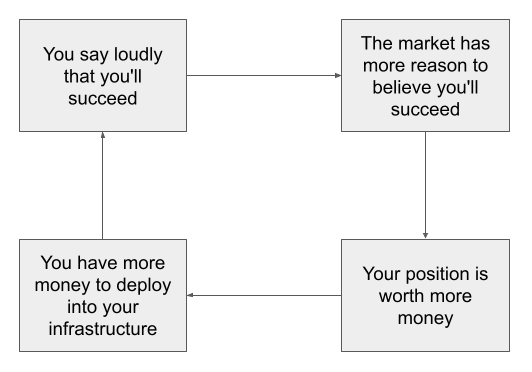
There's precedent for private market participants to generate revenue for what they build via derivatives. A famous recent example is billionaire "Big Shot" Xiang Guangda of Tsingshan Holding Group, who announced new nickel production lines in 2021 and attempted to amplify his returns by trading. This is the story of how that went horribly wrong.
To understand Xiang's trade, you need some background on nickel. Nickel can have various levels of purity: nickel ore (~2% purity), nickel pig iron (~10%), nickel matte (50-75%), and refined nickel (99%+). Class 1 nickel requires 99.8% purity, and it's tradeable on the London Metal Exchange (LME), whereas lesser purities are called Class 2 nickel. Nickel is an input into stainless steel, batteries, and a handful of alloys.
In early 2021, Xiang announced new Indonesian nickel production lines to convert nickel pig iron into nickel matte. Until then, the only realistic option for batteries was refined nickel, because there wasn't enough nickel matte supply. Since battery manufacturers were expected to buy nickel matte instead of refined nickel once Xiang's production lines went live, LME Class 1 nickel dropped by 9% that same day.
But through 2021, the demand for electric vehicles was so strong that the refined nickel price rose anyway. EV batteries physically consumed larger and larger proportions of the Class 1 nickel supply. Xiang's view was that the price rally didn't adequately account for his upcoming nickel operations, so he opened a large short position on Class 1 nickel.
In a commodities market, some participants are speculating, and they intend to eventually close their trade. Buyers need to sell their position, and sellers need to buy back their position. Xiang was a speculator who sold. Other market participants buy or sell because they are physically consuming or producing the commodity.
Multiple dynamics were at play. EV battery manufacturers needed to take delivery, so when they bought Class 1 nickel, they had no intention of selling. The remaining sellers were speculators. Eventually, Xiang needed to buy to close his trade, and he'd be at the mercy of the speculators.
Not long after, Russia invaded Ukraine in early 2022. Russia is one of the largest producers of refined nickel, and markets were concerned about a potential sanction. Class 1 nickel prices skyrocketed.
All the reasonable sellers had already sold their Class 1 nickel to the battery manufacturers. Xiang's short position was large enough that the remaining participants were only willing to sell at unreasonably high prices. On top of that, his production was for nickel matte, which is not Class 1 nickel, so he couldn't physically meet his obligations either.
The remaining sellers understood Xiang's dilemma, and they held. This trade would have bankrupted Xiang's company. Luckily for him, the LME halted the nickel market and cancelled all of the trades that day, which became the subject of a (later dismissed) lawsuit from Jane Street and Elliott. Typically when a trade is losing this much money, brokers will force a trader to exit their position and take the loss. Instead, banks agreed to hold off on liquidating Xiang's position, and he was able to fully close by mid-2022 as markets settled down.
The most common takeaway from this story is "I wouldn't want to be the nickel guy." The reality is more nuanced. In theory, Xiang could have just profited from his nickel production lines and avoided trading altogether. But note that by late 2023, Xiang's prediction for refined nickel came true, and the nickel finally traded below his entry price.
It's sort of a shame, right? On some time frame, Xiang was right. He had superior knowledge of the upcoming market impact from his physical operations. Where did he go wrong?